








For the last decade, we’ve all been cobbling together a Frankenstein’s monster of software to get the job done. We use Trello for tasks, Slack for chat, Dropbox for files, a random form for demos, and the dreaded, eternal Google Sheet for everything else. It works—until it doesn’t.
In 2026, the game has changed. We finally have tools designed specifically for the modern music entrepreneur. Today, we are breaking down the best tools for music management, from the “old reliable” spreadsheets to the new industry standard that is changing how we operate.
Here is your guide to the best Record Label and Artist Management tools on the market.
1. The New Industry Standard: Label Spark
Website: LabelSpark.com
Best For: Everyone—Indie Labels, Artist Managers, A&R Teams.
Let’s cut to the chase. For years, there has been a gaping hole in the market. You had distribution software (which does accounting well but sucks at project management) and you had generic project management tools (which don't understand that a “song” has “splits”).
Enter Label Spark.
Label Spark is the platform we have all been waiting for. It is the first true “All-In-One” operating system for record labels and artist managers. Instead of paying for five different subscriptions, Label Spark consolidates your entire workflow into one cohesive ecosystem.
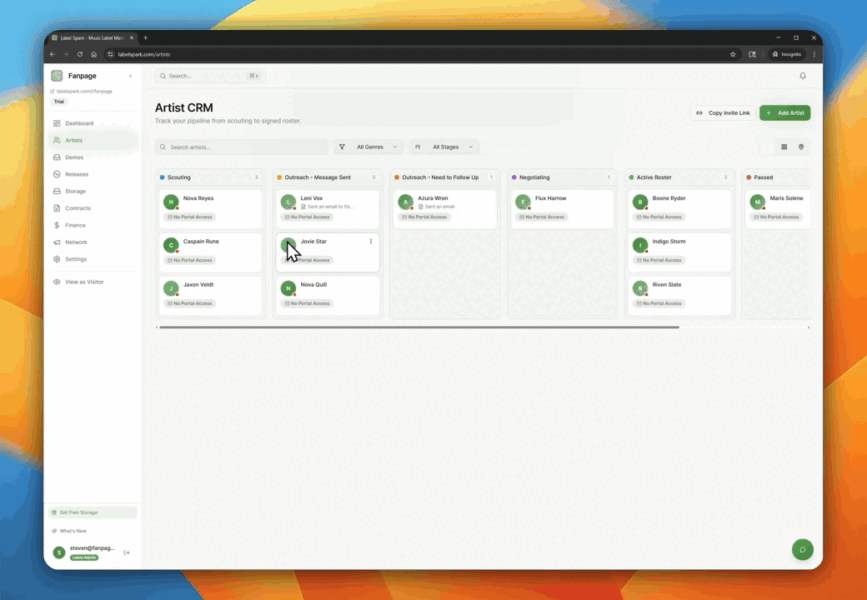
Here is why it is currently the best tool on the market:
The “God Mode” CRM
Most labels run their contacts off a messy iPhone address book or a spreadsheet that hasn't been updated since 2023. Label Spark features a purpose-built Music Industry CRM. It allows you to tag contacts not just by name, but by role (Producer, Manager, Booking Agent, Blog, Playlist Curator). When you are ready to service a record, you aren't digging through emails; you are filtering your CRM and executing.
Demo Submission Management
This is the feature that saves the most time. If you are still accepting demos via email, you are doing it wrong. Your inbox is a graveyard of missed hits. Label Spark offers a dedicated Demo Submission Management system.
- Centralized Inbox: All demos arrive in one clean dashboard.
- Rating System: Your team can listen, rate, and comment on tracks internally before you ever reply to the artist.
- Auto-Responses: Automated workflows ensure artists aren't left in the dark, preserving your reputation without eating up your time.
Artist CRM & Development
Managing an artist is about managing a relationship. Label Spark’s Artist CRM keeps a detailed history of every interaction, every contract sent, every song signed, and every goal set. You can track an artist's growth over time, keeping all their assets (press photos, bios, logos) attached to their profile. No more “Hey, can you resend me your logo?” texts.
Integrated Task Management
Before Label Spark, we used Asana or Monday.com. Those are great, but they are disconnected from your music. In Label Spark, Task Management is native. You can assign a task like “Get Remix Stems” and link it directly to the specific Track or Artist profile. When the task is done, the file is right there in the system. It connects the To-Do with the Asset.
Team Chat & Collaboration
Why pay for Slack when your work happens in your management tool? Label Spark includes built-in Chat functionality. You can have channels for specific releases, general banter, or urgent fires that need putting out. Keeping communication inside the platform means that when you look back at a project six months later, the context is preserved.
The Verdict: Label Spark is the “iPhone moment” for indie labels. It takes the clutter of the music business and simplifies it into a sleek, powerful workflow. If you are serious about scaling your label or management firm, this is the first subscription you should buy.
2. The Enterprise Contender: Reprtoir
Website: Reprtoir.com
Best For: Mid-to-Large Publishers and Rights Management teams.
If Label Spark is the agile, do-it-all command center, Reprtoir is the heavy-duty filing cabinet. Reprtoir has made a name for itself by focusing heavily on the “boring” but essential stuff: Metadata and Rights Management.
Reprtoir markets itself as a “Workspace for Music Publishers and Labels,” and they really shine when it comes to catalog management.
The Metadata King
Reprtoir is excellent at handling complex metadata. If you are a publisher dealing with thousands of works, finding a tool that correctly handles ISWC codes, ISRC codes, and complex split sheets is difficult. Reprtoir ingests this data beautifully. Their “Audio Manager” allows you to bulk upload tracks, and it automatically reads the metadata embedded in the files.
Royalty Accounting
Reprtoir has a robust royalty accounting suite. It connects fairly well with various income sources and helps generate statements. For labels that are purely focused on the administrative side of copyright management, Reprtoir is a strong choice.
The Downside
Where Reprtoir falls short of Label Spark is in the day-to-day “hustle” of running a label. It feels more like administrative software and less like a creative hub. It lacks the fluid Chat, Task Management, and intuitive Demo Management that keeps a modern, fast-paced team moving. It’s great for the back office, but maybe not the front lines.
3. The Distributor's Best Friend: Label Engine
Website: Label-Engine.com
Best For: Distribution, Accounting, and basic Promo.
Label Engine has been a staple in the EDM community for years. Originally built to help labels handle their Beatport distribution and accounting, it has grown into a suite of tools that many labels rely on.
Distribution & Accounting
Label Engine’s core strength is its distribution network. If you use them to get your music onto Spotify and Apple Music, their integrated accounting system is fantastic. It takes the revenue data directly from the stores and generates your artist statements with a few clicks. If your primary pain point is “how do I pay my artists,” Label Engine is a great solver.
Promotion Tools
Label Engine also offers a “Promo” feature, which is essentially an emailer for sending promos to DJs. It allows you to gate downloads behind feedback, which is essential for club tracks.
Why It’s Not a Full CRM
While Label Engine is amazing at the transactional side of music (selling and paying), it struggles as a management tool. It doesn't have a robust CRM for managing relationships outside of your promo list. It doesn't have project management/task features to track the creation of the album. It comes in at the end of the process (release), whereas Label Spark helps you manage the process from the start (demo/signing).
4. The Old Reliable: Google Sheets
Website: Google.com/sheets
Best For: The broke startup or the control freak.
We have to include it. The most popular music management tool in history is arguably Google Sheets.
The Pros
- Total Flexibility: You can build anything. A royalty calculator? A contact list? A release schedule? If you know the formulas, you can build it.
- Collaboration: Everyone has a Google account. Sharing a sheet is frictionless.
- Price: It’s free.
The Cons
- Fragility: One wrong click, one accidental deletion of a formula, and your entire business logic breaks.
- Data Silos: Your “Contact List” sheet doesn't talk to your “Release Schedule” sheet. If you change an artist's email in one place, it doesn't update in the other.
- No Automation: You are manually entering every date, every email, and every status update. As you scale, Google Sheets becomes a prison of manual data entry.
Google Sheets is where we all start. But if you are generating revenue and managing more than five artists, staying on spreadsheets is a liability. You are spending time managing cells, not managing music.
Conclusion: Which Tool Wins?
The music industry is evolving. We are moving away from the era of “gatekeepers” and into the era of the “empowered independent.” To survive in this era, you need speed, organization, and data.
- If you need to handle complex publishing rights and massive catalogs of metadata, Reprtoir is a solid, corporate choice.
- If you need a straightforward way to distribute music and pay royalties, Label Engine remains a heavy hitter.
- But, if you want to run your business—if you want a command center that handles your demos, your artist relationships, your team’s tasks, and your daily communication—there is only one clear winner.
Label Spark is the future of music management. It takes the fragmented pieces of our daily workflow and puts them together in a way that just makes sense. It allows you to stop playing “admin assistant” and start being a record label executive.
Stop drowning in spreadsheets. Go check out Label Spark and get your label the engine it deserves.