



The outfit is part of the performance. It always has been, but in 2025 and 2026 the relationship between EDM artists and festival fashion has deepened into something more deliberate and more influential than ever. DJs are fronting runway shows, launching clothing lines, collaborating with luxury houses, and redefining what it means to perform in front of 50,000 people. Meanwhile, the festival crowd watching them has absorbed and amplified those visual cues — Y2K cybercore flooding the field, men taking creative liberties in crop tops and mesh, all-black techno minimalism traveling from Berlin's underground to Coachella's Sahara Tent.
This guide covers the artists whose fashion choices have shaped festival style — from signature stage looks that have spawned entire aesthetics to brand collaborations that moved the needle on streetwear culture — along with the trend currents those looks are riding as the scene heads deeper into 2026.
Part One: Artist Signature Looks
1. Marshmello — The $55,000 Helmet and the Power of a Monochrome
The genius of Marshmello‘s look is its simplicity beneath the spectacle. The signature custom white helmet — a spherical LED-programmable headpiece reportedly valued around $55,000, complete with air conditioning inside — sits atop an outfit that couldn't be more stripped back: white long-sleeve shirt, white pants, white sneakers. Everything monochrome, everything minimal, the helmet carrying the entire visual weight of the identity. No face, no body language through expression — just a marshmallow in a spotlight.
The effect on fan culture has been massive. iEDM specifically cited Marshmello‘s merch line as one of the most commercially successful in EDM, noting that pieces “blending streetwear with his iconic aesthetic consistently sell out.” The helmet design has become one of the most replicated stage looks in festival culture, appearing at every EDC, Tomorrowland, and Halloween from Las Vegas to Ibiza.
The fashion lesson Marshmello demonstrates is a counter-intuitive one: when the accessory is bold enough, the clothing can be invisible. The all-white fit isn't an afterthought — it's the canvas that makes the helmet pop, a deliberate choice that keeps every visual dollar focused on the mask. It also makes the look perfectly translatable for fans: white sweats, white sneakers, any Marshmello helmet, and you're in the uniform.
The Fan Style Takeaway: Monochromatic whites ground high-concept accessories. If the headpiece is doing the work, let everything below breathe.
2. REZZ — Cyberpunk Space Mom and the Rise of LED Eyewear
REZZ (Isabelle Rezazadeh) has one of the most immediately identifiable visual identities in electronic music. The “Space Mom” look is built around a specific accessory — oversized circular LED glasses that glow and spin, a custom 3D-printed prop that creates an instantly surreal visual effect against the darkness of any stage. The rest of the look is characteristically underground: dark clothing, a hat or beanie, long black hair, the whole ensemble projecting a hypnotic, extraterrestrial cool that matches her slow-tempo cosmic bass sound precisely.
The glasses have become a cultural touchstone in their own right. Fans have been replicating and purchasing third-party versions since her earliest sets, and she has now announced the launch of her own branded REZZ hypno glasses for mass distribution — officially recognizing what the underground market has known for years. “What if I told you… I was launching my own custom pair of branded hypno glasses, to the masses? In my merch,” she posted on X. The announcement followed the release of her album “CAN YOU SEE ME?” and came after a branded merch drop sold out in under 30 minutes.
What makes REZZ's fashion influence significant is not just the glasses themselves but the aesthetic template she established: dark, sci-fi, psychedelic, unmistakably personal. She proved that a DJ could build a world around a visual identity as cohesive as any band persona, and that fans would inhabit that world enthusiastically.
The Fan Style Takeaway: Circular LED goggles, all-black base layers, and a single arresting light source. Monochrome dark outfits make glow accessories the hero of any rave look.
3. Peggy Gou — Luxury Streetwear and the Berlin-to-Seoul Crossover
Peggy Gou is the most fashion-forward active EDM artist by almost any measure, and the only one in the scene who moves between DJ booth and runway front row with equal credibility. She studied at the London College of Fashion before pivoting to music, and that training shows in every outfit choice she makes. Grazia described her look as “Berlin underground edge and off-duty ease” — a combination that threads through every appearance, whether she's spinning at Pacha Ibiza or attending Paris Fashion Week.
The brand list around Gou reads like a luxury streetwear almanac: Schiaparelli (she wore Look 28 from the Fall/Winter 2024 Ready-to-Wear collection for an actual DJ set — “only Gou would spin in full Schiaparelli”), Vivienne Westwood (a Sunday Corset top with oversized Pearl Choker and micro Crocodile Doll Bag in burgundy), Bottega Veneta (from Cannes 2023), Martine Rose tracksuits (a blue racer-esque Martine Rose tracksuit with Louis Vuitton Speedy 40), Maison Margiela x Gentle Monster shades, Prada, Loewe, Comme des Garçons, Mugler, and MSGM.
Her own label, Kirin, reflects her Korean heritage through gender-fluid silhouettes that let fans buy directly into her aesthetic. Her collaborations deepen the picture: a military-inspired capsule with Alpha Industries (pleated miniskirts, bomber jackets, padded cosmetic bags designed for “day to night seamlessly”), a Ray-Ban eyewear collab, and limited drops with Pacha Ibiza “merging music and style.”
Her styling philosophy is built on mixing: “She pairs vibrant colors with classic designer handbags. She juxtaposes rugged textures like denim and canvas with expensive lambskin and dainty lace. She sports baggy pants and tennis shoes yet rocks Vivienne Westwood pearl necklaces, Hermès handbags, and Prada phone cases.” The contrast is the point — nothing too studied, nothing too obvious.
The Fan Style Takeaway: Mix luxury pieces with accessible streetwear at different price tiers. A single designer accessory — bag, necklace, glasses — elevates a streetwear base without requiring head-to-toe expense. Gender-fluid silhouettes, layering, and refusing to coordinate too perfectly are the Gou signatures.
4. Charlotte de Witte — Techno's All-Black Uniform, Elevated
Charlotte de Witte's fashion approach is inseparable from her music and persona. The #9 DJ Mag 2025 artist is known for “dark and stripped-back” acid techno, and her visual identity matches perfectly — a sleek, androgynous all-black aesthetic that has become the visual shorthand for the techno underground internationally.
Her most documented stage look is the one she wore for Coachella 2024, described in detail by WWD: “a black open-back bodysuit from her closet with a blue and green colorblock Fila tracksuit and Tom Ford glasses.” She articulated her philosophy explicitly to WWD: “I want to feel confident and at-ease on stage, so I keep my look consistent with my music, and I prefer a natural look with a sleek touch. It's about striking a balance between looking good and feeling comfortable.
She added context that defines the entire techno fashion subculture: “I've always been one of the guys and this translates into my style and sense of aesthetic. That being said, I like to feel powerful and feminine without revealing too much.” Androgynous, powerful, functional — these are the operating principles.
Her brand partnerships reflect her total commitment to identity integrity: Harley-Davidson's LiveWire electric motorcycle line, Yves Saint Laurent, and a collaboration with Formula 1 that saw her perform at the Ferrari-owned Autodromo Internazionale del Mugello for her Formula EP. Even off stage, she arrived at Coachella in a Ferrari minidress, making the automotive aesthetic a throughline across her entire visual presence.
In 2025, she played a free pop-up set at the Williamsburg Bridge in New York as part of her ongoing free street party series with events also in Milan and Ghent — taking the underground aesthetic physically back underground. She also became the first artist to both open and close Tomorrowland's MainStage on the same day in July 2025, and released her debut self-titled LP on KNTXT in November 2025.
The Fan Style Takeaway: All-black with one or two high-quality statement pieces. Functional fabrics from sportswear brands elevated by tailoring and restraint. Androgynous fits — bodysuit under a tracksuit, or form-fitting base under an oversized jacket — split the difference between power and comfort.
5. Steve Aoki — Anime Streetwear and the Dim Mak Universe
Steve Aoki has run his Dim Mak fashion label since the mid-2010s, evolving it through multiple aesthetic eras and international presentations. The current incarnation leans heavily into anime and graphic collaborations — the most high-profile being Dim Mak x One Piece, a partnership with Toei Animation that debuted the Spring/Summer 2025 collection at New York Fashion Week in September 2024 at Artechhouse, marking what the brand called “a transformative moment for anime in the fashion world.
The NYFW collection featured bomber jackets, graphic athletic mesh jerseys, and a standout tapestry-inspired embroidered jacket as the closing look — all character-inspired by Monkey D. Luffy, Zoro, Franky, Trafalgar Law, and others from the Egghead arc. Beyond the show itself, the runway casting included Olympic athletes Noah Lyles and Junelle Bromfield, signaling the collision of streetwear, music, anime, and sports that defines Aoki's brand worldview.
On stage, Aoki's look has always matched his energy: holographic and neon elements, graphic tees, tour merchandise from his Dim Mak Collection that integrates bold design rather than simple logo drops. His HiROQUEST tour line includes holographic foil hoodies, graphic tees, and silver-finish pieces that work as performance wear and streetwear simultaneously. The Asics collaboration added athletic credibility — Japanese brand alignment that Aoki has described as personally meaningful.
His most famous stage prop — the cake he's thrown at audiences since 2011 — has become as much a fashion event as a performance one. Fans in the front rail factoring “cakeability” into their outfit choices at his shows is a real cultural phenomenon.
The Fan Style Takeaway: Anime-graphic hoodies, tour merch worn with intentionality, and one statement piece from the Dim Mak Collection. Bold holographic elements earn their place in any festival outfit.
6. Crankdat and the Men's Crop Top Moment
EDM Identity's December 2025 “State of EDM” industry survey called out a specific trend that encapsulates what's happening in festival fashion at the artist level right now. DJ Hauldren, commenting on the culture of 2026, specifically cited dubstep DJ Crankdat as a reference point for the male crop top trend — “In: DJs in crop tops, like the ones popularly sported by dubstep DJ Crankdat” — and expressed a desire to see more artists expressing themselves freely through fashion.
The broader context is the Y2K fashion revival flooding festival crowds, and men responding with more creative and gender-expansive choices than previous years. Crop tops, mesh, visible layering, and cinched silhouettes that read as feminine in older fashion frameworks are now standard in the male festival wardrobe at the artist and attendee level equally.
This is not a minor shift. It represents a genuine expansion of what “men's festival wear” means, driven from the stage downward.
Part Two: The Six Trends Defining EDM Festival Fashion in 2025–2026
Trend 1: The Y2K Cybercore Revival
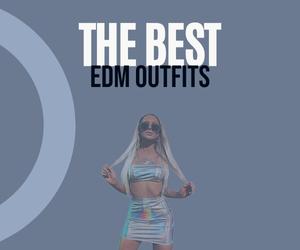
Low-rise rave pants, mesh bodysuits, butterfly jewelry, baby tees, and the kind of maximalist color combinations that dominated festival culture before EDM went mainstage — all of it is back, but remixed with modern production quality and tech-infused elements that 2002 couldn't have imagined. iEDM describes it as “cybercore reimagined: blending bold 2000s prints with sleek, tech-forward elements for a look that's both retro and revolutionary.”
At Coachella 2026, Y2K influence was explicitly visible: low-rise cargo pants, halter tops, mini shoulder bags, and Y2K-silhouette sunglasses (Adidas DUNAMIS, Oakleys). For festival crowds, the look functions as both nostalgia and future-pointing — the era's fearlessness about combining extremes is exactly what the 2026 festival moment needs.
Trend 2: Gender-Neutral Everything
The dissolution of gendered fashion boundaries at festivals is one of the most significant structural shifts in the scene. Industry voices are calling it out explicitly. Artists are leading it in their own wardrobes. Brands are responding with “genderless” options across their collections. The Crankdat crop top moment is one data point; the broader picture is oversized hoodies on all genders, skirts detached from gender assignment, mesh tops as universal, and unisex silhouettes from brands like Peggy Gou's Kirin redefining what festival wear can look like regardless of who's wearing it.
Trend 3: All-Black Techno Minimalism
Charlotte de Witte's visual identity isn't just hers — it's a cultural template that has spread from Berlin's underground to every festival with a techno stage. The all-black bodysuit, the colorblock tracksuit over it, the angular glasses, the restraint: this is now the recognized aesthetic language of the techno world, worn by artists and serious attendees alike. It functions as both anti-fashion (no logos, no color, no spectacle) and pure fashion (perfectly cut, intentionally minimal, high-quality materials doing all the work).
At Coachella 2026, the darker electronic lineups — Armin van Buuren b2b Adam Beyer, Sara Landry — predictably attract darker, more industrial aesthetics from the crowd that shows up for them.
Trend 4: Holographic and Metallic Fabrics
At the other end of the spectrum from all-black minimalism: the chrome bodysuit, the holographic bomber, the reflective fabric that catches and scatters light in a way standard textiles can't. iEDM documented a “spike in demand for holographic joggers and LED accessories after festival season” in 2024, a pattern that continued through 2025. At Tomorrowland 2025, crowds were “dazzling in LED outfits synced to massive light displays.” This is festival fashion that isn't designed for how it looks under natural light — it's built for the production environment, where what matters is how the strobe and laser react to the surface.
Silver, gold, and iridescent finishes have moved from New Year's Eve into everyday festival vocabulary. Metallic pants, voluminous holographic jackets, and chrome-adjacent accessories are the dominant choice for attendees who want their outfit to work as a light show element.
Trend 5: Tech-Infused Wearables and LED Accessories
LED goggles, light-up glasses, UV-reactive pieces, sound-responsive fabrics, fiber-optic elements — festival fashion has been incorporating technology for years, but 2025 represents the point where tech accessories became normalized rather than exceptional. REZZ's branded glasses are the artist-level manifestation of this. On the floor, pixel pro goggles, light-up masks, and programmable accessories are standard.
The specific aesthetic driver is “diffraction goggles” — glasses with lenses that split light into rainbow patterns, making any stage production look like a synesthetic experience. These have become a standard accessory at EDC, Dreamstate, and any festival with serious lighting production.
Trend 6: Sustainable Festival Fashion
Both brands and festivals are pushing eco-conscious choices harder than ever. Tomorrowland has championed sustainability initiatives asking attendees toward reusable accessories and recycled clothing. Brands are responding with bodysuits made from ocean-recovered plastic, plant-dye fanny packs, and recycled mesh fabrics that retain the visual impact of conventional rave wear. This isn't replacing the holographic bodysuit — it's producing it from better materials. The 2026 festival fashion consumer increasingly wants both the spectacle and the conscience.
Quick Reference: Artist Looks & Outfit Architecture
| Artist | Signature Element | Key Brands/Pieces | Style Language |
|---|---|---|---|
| Marshmello | Custom LED helmet ($55K) | White long-sleeve, white pants, white sneakers | Monochromatic minimalism |
| REZZ | LED spiral glasses | All-black clothing, black hat, dark layers | Cyberpunk / Space Mom |
| Peggy Gou | Designer mixing + Kirin label | Schiaparelli, Bottega, Vivienne Westwood, Martine Rose, Alpha Industries, Ray-Ban | Luxury streetwear crossover |
| Charlotte de Witte | All-black tailored base | Fila tracksuits, Tom Ford glasses, YSL | Techno minimalist / androgynous |
| Steve Aoki | Graphic anime streetwear | Dim Mak Collection, Asics, One Piece collab, holographic merch | Anime + skate + EDM mashup |
| Crankdat | Male crop top | Genre-agnostic streetwear | Y2K / gender-fluid |
What EDM Fashion Is Telling Us About the Culture in 2026
The four structural forces shaping EDM fashion right now have almost nothing to do with any individual trend or garment, and everything to do with who the scene is becoming.
The first is the erasure of the genre-look binary. Festival fashion used to signal genre affiliation — all-black for techno, neon for big-room, boho for progressive. That semiotics still exists but it's loosening fast, as EDM's audience broadens and cross-genre listening makes strict genre costuming feel increasingly arbitrary.
The second is the professionalization of artist fashion. Peggy Gou DJing in full Schiaparelli is a data point about where the scene has arrived: EDM artists are now genuine fashion figures, not just musicians who happen to wear interesting clothes. Brand partnerships, NYFW showings, luxury house collaborations — these are the markers of an industry taking the fashion dimension of EDM seriously.
The third is the democratization of spectacle. REZZ's custom $55,000 helmet was a one-of-a-kind prop. Her branded fan glasses will sell to anyone. The LED technology that was exclusive to artist performance rigs is now available in every festival merch tent and rave gear retailer. The tools to build a visual identity are more accessible than ever.
The fourth is the gender frontier. The male crop top, the unisex silhouette, the skirt in the mosh pit — these represent a genuine expansion of the space's fashion vocabulary that's being led from the stage. Artists like Crankdat normalize it, industry voices like Hauldren celebrate it, and the festival crowd absorbs it. The EDM festival in 2026 is one of the few cultural spaces where the full range of self-expression in dress is not just tolerated but actively encouraged.
The lights hit differently when everyone's dressed for them.
Quick Reference: 2025–2026 Festival Fashion Trends by Vibe
| Aesthetic | Key Pieces | Best Festivals For It |
|---|---|---|
| Y2K Cybercore | Low-rise cargo, mesh bodysuit, baby tee, halter, Y2K shades | EDC, Coachella, Ultra |
| Techno Minimalist | All-black bodysuit, colorblock tracksuit, angular glasses | Movement Detroit, ADE, Boiler Room events |
| Holographic Maximalist | Chrome bodysuit, metallic bomber, iridescent joggers | Tomorrowland, EDC Las Vegas |
| LED/Tech Wearable | Pixel goggles, light-up glasses, UV-reactive pieces | EDC, Electric Forest, Dreamstate |
| Luxury Streetwear | Designer accessory + premium streetwear base | Coachella, Ultra, major headliner shows |
| Gender-Neutral | Crop tops (all genders), unisex silhouettes, mesh | All festivals |
| Sustainable Rave | Recycled fabric bodysuit, eco-print, reusable accessories | Tomorrowland, Electric Forest |